
Introduction
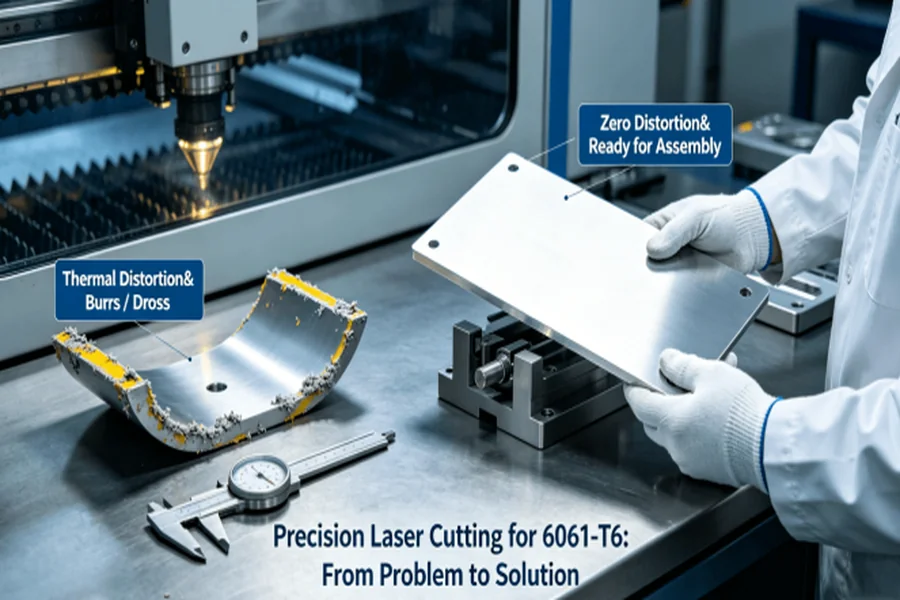
As the quest for weight saving continues in the fields of automotive manufacturing, aircraft construction, and consumer electronics applications, 6061-T6 aluminum alloy is always chosen by engineers for its ideal strength-to-weight ratio. However, the major challenge faced in the field involves thermal distortion and burring in conventional laser cutting, which causes issues such as part failure during assembly, increased expenses for secondary machining, and even weakening of the material’s temper.
The reason behind this problem is lack of control of the laser energy transfer into the material along with the poor setting of other process parameters causing high thermal inputs. The focus of this paper is on exploring the precision laser cutting of aluminum alloy through an industrial laser cutting procedure that utilizes sophisticated process control to provide zero thermal distortion and outstanding cut edges. The resulting products are ready to be processed further for anodizing and assembly without any secondary operations involved.
Why is Thermal Control So Critical in Laser Cutting 6061-T6 Aluminum?
The Duality of Material Properties
6061-T6 aluminum is favored for its high strength, lightweight nature, and good machinability. Yet, its high reflectivity and thermal conductivity present a natural challenge for lasers. High reflectivity makes it difficult for the laser beam to couple its energy efficiently into the material, while high conductivity causes any input heat to spread rapidly. Inadequate control readily induces widespread thermal effects.
l Loss of Core Strength
The T6 designation signifies a solution heat-treated and artificially aged state that yields peak strength. Excessive heat input from improper 6061-T6 Aluminum Laser Cutting can cause over-aging, coarsening the strengthening precipitates and irreversibly degrading the alloy’s core mechanical properties.
l Unpredictable Part Warping
The local overheating also induces non-uniform stresses inside the material. After cooling, due to the release of stress, the component will be bent, twisted, or bowed – this process is known as thermal distortion. This results in parts that exceed tolerances.
The HAZ: The Ultimate Benchmark of Quality
Thus, the key factor that defines the quality of Precision 6061-T6 Laser Cutting is control of the width and change in the structure of the Heat-Affected Zone (HAZ). With the formation of a thin HAZ, the material retains its properties, ensuring the fatigue resistance of the final product. Besides cutting, this type of manufacturing process demands precision in terms of heat, especially during aluminium marking for automotive industry.
How Do Advanced Laser Processes Achieve True Burr-Free and High-Precision Cutting?
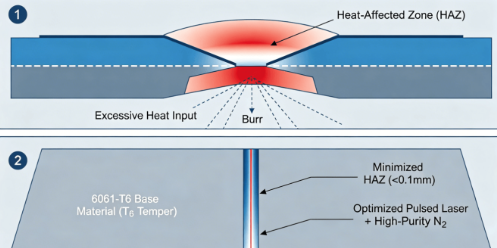
The main factor of laser cutting high precision aluminum or getting the so called burr-free edges is how finely we interfere with the cutting physics. During laser cutting, the metal is melted and then the molten metal is pushed away from the kerf (the slit made by the laser beam). If it is not molten metal is perfectly ejected, the leftover will re-solidify as dross on the bottom edge, which is the main cause of burrs. Properly syncing the gas and the laser is the secret of getting great edge quality. Using a high-purity, high-pressure nitrogen assit gas not only prevents oxidizing but also blows the molten material rather than burning it. Real-time, closed-loop power control and ultrafast pulsing technology are combined to control each laser pulse’s energy very accurately, which in turn stabilizes the melt pool and minimizes slag sticking at the source. Accuracy in laser cutting results from the triple interplay of optics, mechanics and electronics.
To get a very small focal spot, first a high beam quality fiber laser is used; then a nanometric motion control system makes sure the absolute trajectory is very accurately done. This allows advanced Laser Cutting Service to produce repeatable position accuracy of 0.05mm and even better, which thoroughly fulfills the strict requirements for complex geometries in Custom Aluminum Laser Cutting. Ultimately, the edge is almost vertical and clean, which allows successful precision assembly and surface treatments such as anodizing, and greatly reduces or even.
How Does Laser Cutting Become the Cost-Optimized Choice Over Traditional Machining for Lightweighting?
Laser Cutting for Lightweight Structures is becoming the affordable choice compared to the traditional CNC milling technique. The limitations with milling include difficulties with tool collision, material wastage, and lengthy cycle time when used for thin walls, intricate rib configurations, or skeletonization due to topology optimization. Non-contact nature and the absence of a cutting tool make laser cutting highly effective, allowing for unlimited design flexibility and high material efficiency.
Aluminum Lightweighting Laser Cutting is suitable for manufacturing components that have been optimized for use in lightweight structures. The ability of nesting software in cutting aluminum makes it possible to fit multiple components on one sheet metal without creating any wastage. In addition, high-quality edges obtained during laser cutting mean that the components can be ready for immediate assembly without requiring machining locating surfaces or deburring techniques typical of milling. This saves time and costs involved in manufacturing each component.
What Special Considerations Do the Automotive and Aerospace Industries Have for High-Precision Aluminum Cutting?
Automotive Industry: Scale, Consistency, and Cost
The automobile industry is on a constant quest for the perfect combination of economy and excellence through high-volume manufacturing. When manufacturing items such as battery housings or body structure parts, precision 6061-t6 laser cutting requires that there is consistent accuracy, sealing, and strength in each product manufactured. This requires an extremely reliable process. It is for this reason that suppliers must be IATF 16949 compliant in order to provide full traceability throughout the manufacturing process.
Aerospace Industry: Performance Preservation and Certification
The aerospace sector has near-absolute requirements for safety and reliability. Here, Custom Aluminum Laser Cutting is not just about precision but about maximizing the preservation of the material’s original fatigue strength and mechanical properties.
l Zero Compromise on Performance
The cutting process must confine the HAZ to minimal levels, as any microstructural damage can become a nucleation site for fatigue cracks. Process parameters require exhaustive validation to ensure part reliability under extreme conditions.
l Assurance of Systems
Conformity to the AS9100D Quality Management System Standard for Aerospace Industries is a basic requirement. Being stricter than other ISO standards, this involves risk management and traceability to ensure that each part of the aircraft satisfies the highest quality requirements.
A Common Need: A Partner from DFM Onward
Both industries share a need not just for a vendor, but for an engineering partner who can engage at the Design for Manufacturability (DFM) stage, with a deep understanding of the end-use application. For those with urgent prototyping or production needs, it is advisable to obtain a professional laser cutting instant quote to quickly assess project feasibility and economics.
What Key Qualifications and Technical Capabilities Should Be Evaluated When Choosing an Aluminum Laser Cutting Supplier?
Choosing the appropriate Aluminum Laser Cutting Service provider will take the work halfway done. Supplier selection can be carried out based on the following factors:
Inquire on the type of lasers used (high-brightness fiber lasers), process modules designed for reflective materials, the tolerance (±0.05mm) and maximum cutable thickness of the material. It helps solve issues like thermal distortions and burr creation.
The certifications of the suppliers act as the firewall against quality inconsistency. ISO 9001 is the quality standard; IATF 16949 specifies additional needs with a focus on defect prevention and automotive industry requirements. AS9100D is the ticket for working in the aviation sector. A supplier like LS Manufacturing with all the certifications gives solid endorsement on the services provided and traceability.
An efficient supplier must provide free DFM analysis to optimize the design for cost savings and ease manufacturing. Furthermore, checking on their in-house post-processing capabilities (blasting, anodizing) is important since it gives a one-stop-shop solution.
Communication efficiency and fast problem solving come into play. A quick way of assessing the capabilities of a supplier will be by reviewing their past project portfolios similar to your requirements.
Conclusion
The success of creating perfect cuts in 6061-T6 aluminum lies in the proper use of temperature control and laser technology. With the help of a company that has precision equipment, the proper processes for aluminum, all of the necessary certifications (such as IATF 16949/AS9100D) as well as extensive industry knowledge, it is possible to overcome all obstacles that lie ahead and produce high-quality components for immediate assembly.
If you are looking for a comprehensive solution for dealing with thermal distortion, lack of accuracy, and high prices for aluminum parts, it is time to take action. Upload your component drawings today to obtain a thorough analysis of the manufacturing process and an immediate quotation by our engineers.
Author Bio
The writer of this paper is an experienced professional with more than a decade of practice in the domain of precision manufacturing, who focuses on the development of modern machining techniques as well as material science, aimed at creating engineering solutions for manufacturing.
FAQs
Q1: How do you minimize the Heat Affected Zone (HAZ) when laser cutting aluminum?
A: Utilizing high-power fiber laser with ultra-fast pulsing technology will make it possible. Localized heat energy can be reduced significantly when using such cutting technique together with appropriate cutting speed and high purity nitrogen assist gas. The heat affected zone in this case can be kept below 0.1mm, ensuring preservation of aluminum alloy 6061-T6 characteristics.
Q2: What kind of accuracy does laser cutting ensure when processing thin-walled aluminum parts with complicated shape?
A: High-precision motion control systems used in advanced laser cutting machines ensure ±0.05mm of positioning accuracy. It is also important to note that even thin ribs of 0.5mm in height can be processed accurately without changing part geometry or dimension.
Q3: What are the minimum diameters of holes and slot widths for laser cut parts made of aluminum alloys?
A: It greatly depends on material thickness. On average, when working with 3mm thick aluminum sheets, it will be possible to create holes with diameter no less than the thickness itself (≥3mm). Slot width dimensions also correspond to that scale. Further details should be determined depending on the specific drawing.
Q 4: Can laser-cut aluminum parts be anodized?
A: Yes. Parts produced by laser cutting using a process optimized for the purpose will have clean edges that do not require any further preparation to achieve effective anodizing. A reliable laser cutting service provides perfectly smooth surface areas for coating application.
Q5: What are the differences between laser cutting of aluminum sheet and CNC Milling?
A: Laser cutting is a contactless method of part manufacturing with no need for tools, suitable for complicated geometries and sheets of metal of low thickness. CNC Milling can produce more precise parts with higher wall perpendicularity and deeper milling.